Content, Labeling and Taxonomy Analysis for Local Library

Project background and description
Fort Vancouver Libraries (FVRL) is in need of new and innovative ways to engage their community, by providing a more accessible and efficient online experience. FVRL has come to our design team to utilize what the industry calls, “Information Architecture,” to help restructure and strengthen the websites labeling content.
- The website redesign centered on the needs and preferences of library patrons by utilizing current literature reviews, demographic studies, and User Research protocols such as user interviews to create personas.
- These personas represent the FVRL patron and helped guide further steps such as the content analyses of the current FVRL website which then structured site maps and redesigns through wireframes.
- Final site changes were then narrowed down and confirmed through repeated assessments of the original design’s labeling and taxonomy, as well as testing of the new modifications, via Chalkmark Tree testing and First-click heatmaps.

User Research Summary
To better understand our users, preliminary research was conducted before administering the User Research Protocol. Understanding library patrons and their website consisted of a literature search across multiple databases such as Social Science Research Network, ResearchGate, LibGuides and Google Scholar.
Following preliminary research, an interview protocol was developed using both gathered insights and user research best practices. Two interviews were conducted—one with a librarian from Multnomah County Library (Hollywood branch) and another with a Student Library Assistant at OHSU Library, both in Portland, Oregon.
User Personas
Library Website Patrons
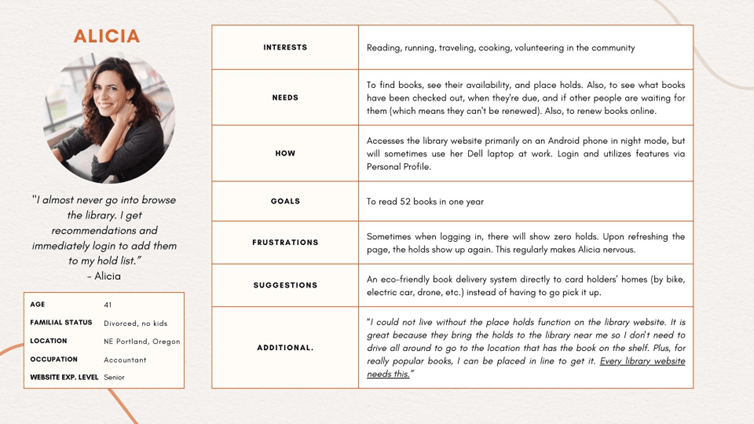
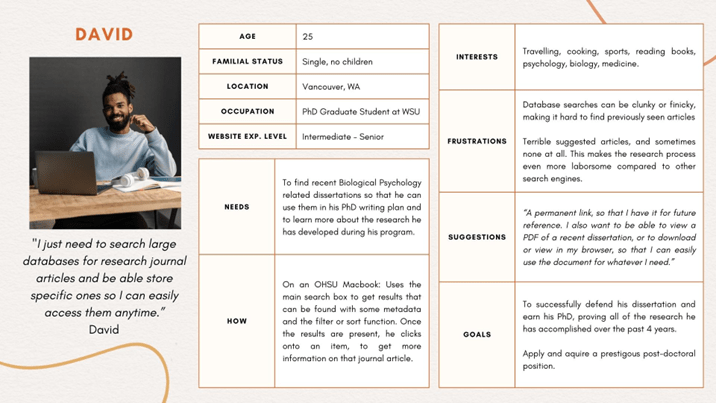
Based on user interviews, literature review, and observed patron behavior, three personas were created: Emily the full-time mom, Alicia the bookworm accountant, and David the time-strapped PhD candidate. These personas reflect key user demographics, goals, common tasks, and the types of information they seek to accomplish those goals.
Primary Persona

Secondary Persona 1
Secondary Persona 2
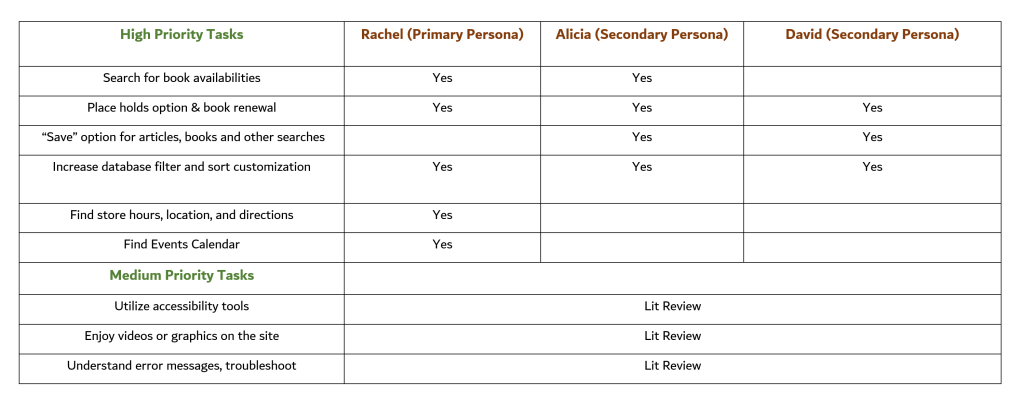
Task Priority by Persona Table
Task Management
Final Sitemap
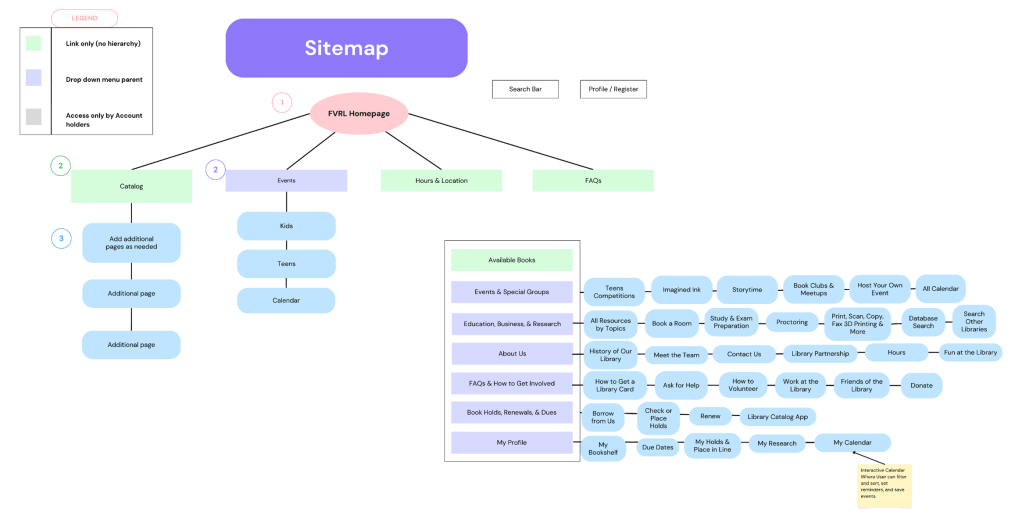
Navigation Structure
The new navigation prioritizes “necessary” over “possible” information, focusing each page on clear calls to action and essential user needs.
- This approach avoids overwhelming users and guides them toward key actions—like registering for a library card, renting a book, or supporting the library.
Old Homepage

- In the library context, conversion isn’t about selling a product but supporting community engagement and practice. With many possible “desirable” user actions, clarity and accessibility are essential.
- For this reason, the redesign utilizes a Co-existing Hierarchical Model
- This allows for flexibility in the new navigation with strong labeling to guide patrons to complete their tasks.
With this navigation structure, patrons’ high priority tasks will have redundant access points, and continuity across all pages.
- As shown in the wireframes, key access points are repeated to ensure completion, benefiting both FVRL and the user.
- These points, from the Global Navigation, are listed below:
- CatalogEvents/ Calendar / Kids eventsHours & LocationsFAQs
- These points, from the Global Navigation, are listed below:
Deliverable
As digitalization becomes the norm for nearly all disciplines, there is an increasing need for municipal libraries to focus on their website experiences. The key wireframes below include all high priority tasks, while remaining as minimal as possible.
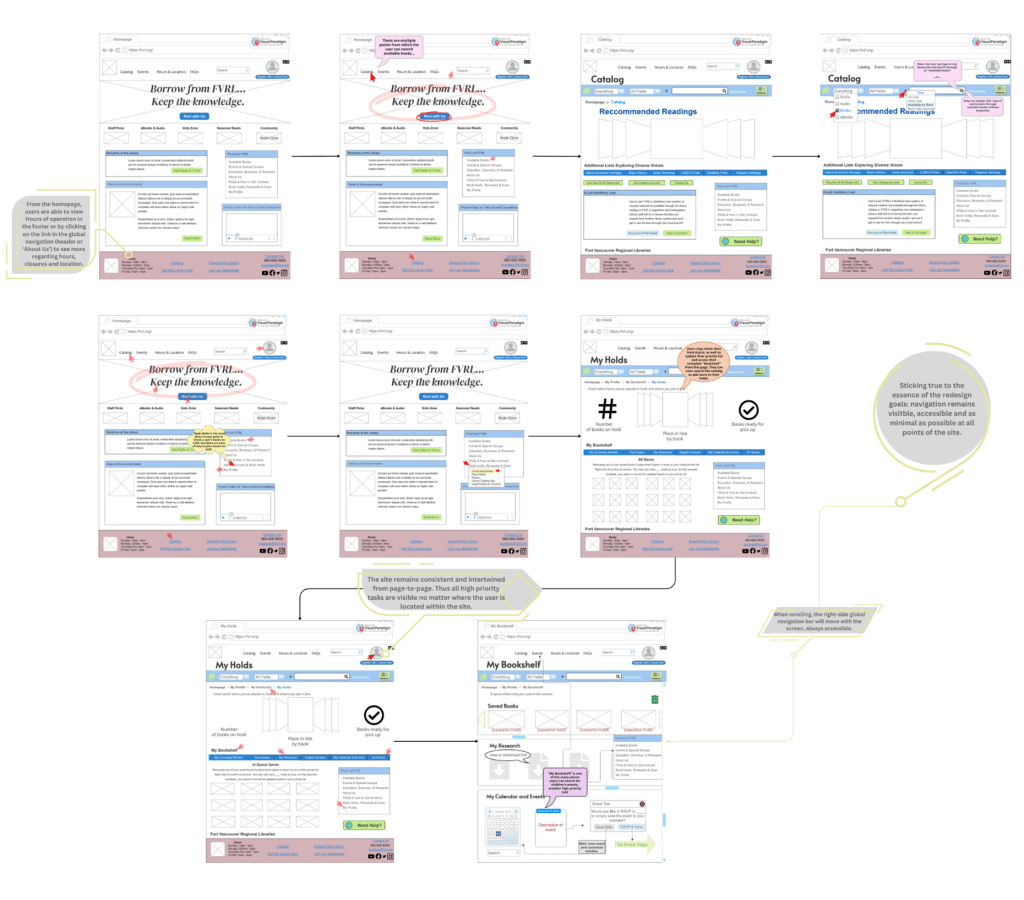
All findings and design decisions were tested and validated through a combination of anonymized, consented user participation—including heat maps, surveys, and iterative testing with updated wireframes—to ensure usability and relevance.
 Kalene Savage