This project explores the experiences, challenges, and motivations of second language learners. Using generative research methods—such as interviews and observations—I uncovered key insights into what supports successful language acquisition. The findings below inform a set of user-centered recommendations for designing more effective language learning experiences.
Executive Summary
Insight One: Conversation is by far the most valued aspect of the language learning process, yet missed the most by apps.
Adult language learners prioritize conversation as the most critical aspect (or goal) of second language acquisition, but it’s also their biggest challenge. Many find popular language apps insufficient in providing opportunities for real-time speaking practice and meaningful interactions, leading to frustration and eventual abandonment of these tools.
Recommendation: To retain users, apps must offer features that facilitate conversations with native speakers and provide live feedback from experts.
Insight Two: Brand Familiarity isn’t always a good thing.
Brand familiarity can sometimes be a drawback, as every participant in our study independently mentioned Duolingo, associating it with a boring, outdated, and overly simplistic learning experience. Users criticized its lack of conversation practice, absence of flashcards and slang, and the pressure of its pushy notifications. This strong association with negative attributes shows that being well-known isn’t always beneficial if the brand is seen as failing to meet user needs.
Recommendation: To combat negative brand perceptions, apps should offer dynamic, real-world content like slang, conversation practice, and more personalized learning experiences (e.g., notifications).
Insight Three: Personalization is important in language learning.
Personalization is crucial in language learning, with users expressing a strong desire to focus on vocabulary relevant to their jobs. As one language learner, Alex, noted:
“I could spend years formally learning Japanese and never learn any of the terms that are relevant to my job…”
Many learners feel that without job-specific content, they struggle to make meaningful progress.
Recommendation: Allow more student-built vocabulary groups. Create profession-based vocabulary or phrase flashcards.
**Each participant received a consent form, and the key points were read aloud to them. Verbal consent was then obtained from all participants.
Participants
The participants (px) consisted of 10 adults with diverse backgrounds in learning second languages, including Spanish, Italian, ASL, French, Japanese, German, Swedish, and Yiddish.
Motivations range from personal, academic, and professional development to travel and cultural heritage.
Some chose to remote self-study via phone apps while others recalled their primary and secondary education classes (ref. Moderator Script). All participants had exposure to at least one formal language course in their lifetime.
Participants were recruited into three groups:
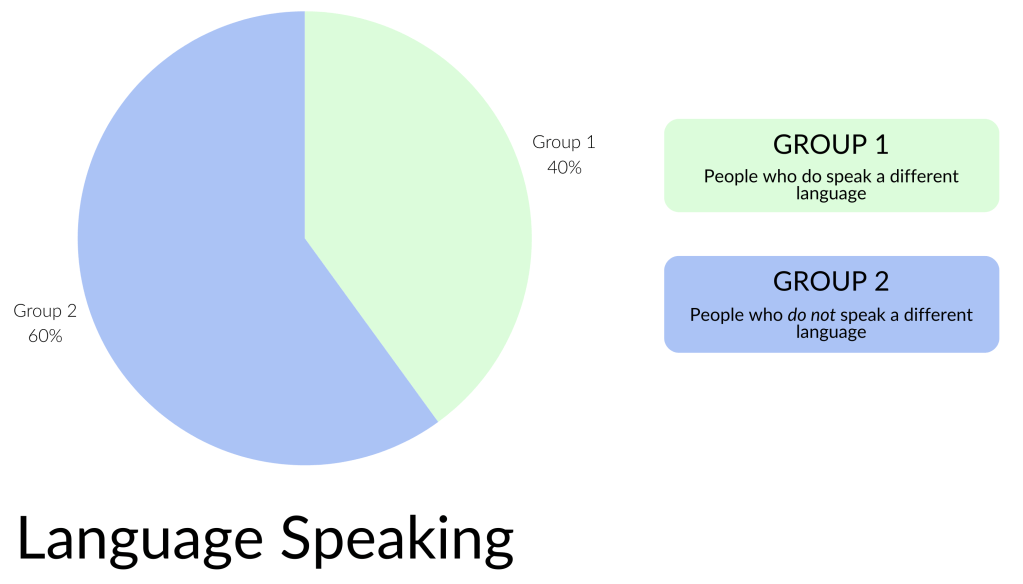
Three of the px were recruited after initial interviews. They were asked several follow up questions as well as observed while using Duo Lingo to complete minor tasks (ref. Follow-Up Moderator Script).
Other Demographics
Age: ranged from 22 years old to 54, with an average age of 34.
Gender: woman-identified px were oversampled compared to male-identified and non-binary persons.
Language Learning Status: 8 out of the 10 px had practiced another language within the past 2 years.
Findings
We found that participants are most familiar with 5 main types of study tools outside of formal education, for language learning:
- Tutoring
- Books (other than textbooks)
- Phone Apps
- Most commonly mentioned: Google Translate, Duo Lingo, Babble, Pimsleur
- Flashcards
- Conversation (speaking, listening)
Research Themes
Motivations and Goals: All participants aimed to improve communication with other speakers. Their goals included:
- Professional enhancement to better serve customers/patients/clients.
- Gaining conversational confidence.
- Achieving fluency, including proper dialect and slang.
- Navigating a new country and reading maps comfortably.
- Learning about personal heritage.
Challenge and Pain Points
Common struggles include discrepancies between formal education and real-world usage, as well as technological limitations in language learning apps. Overall, the group represents a broad spectrum of language learning experiences and challenges.
- Pronunciation
- Grammar
- Practical application
- Conversational fluency
Effectiveness of Current Solutions
All px answered on a scale of 1-5. The lowest score reported was 2, with 5 reported by one person. The average score across all px was 2.6 (ref. Satisfaction Rate via Figma).
Opportunities for Improvement
By far, the most preferred way to learn was through
CONVERSATION.
All but one px said they either wished that they had the opportunity to converse with native speakers, AI, or at least work with an “in-app tutor.”
The px who did not state a preference for conversation, however, did mention a main struggle to be lack of language use & speaking opportunities.
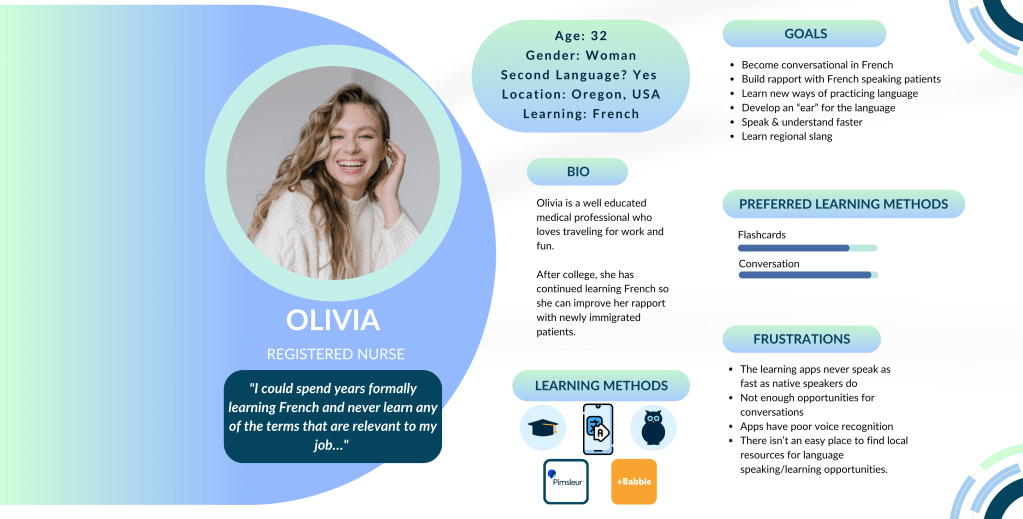
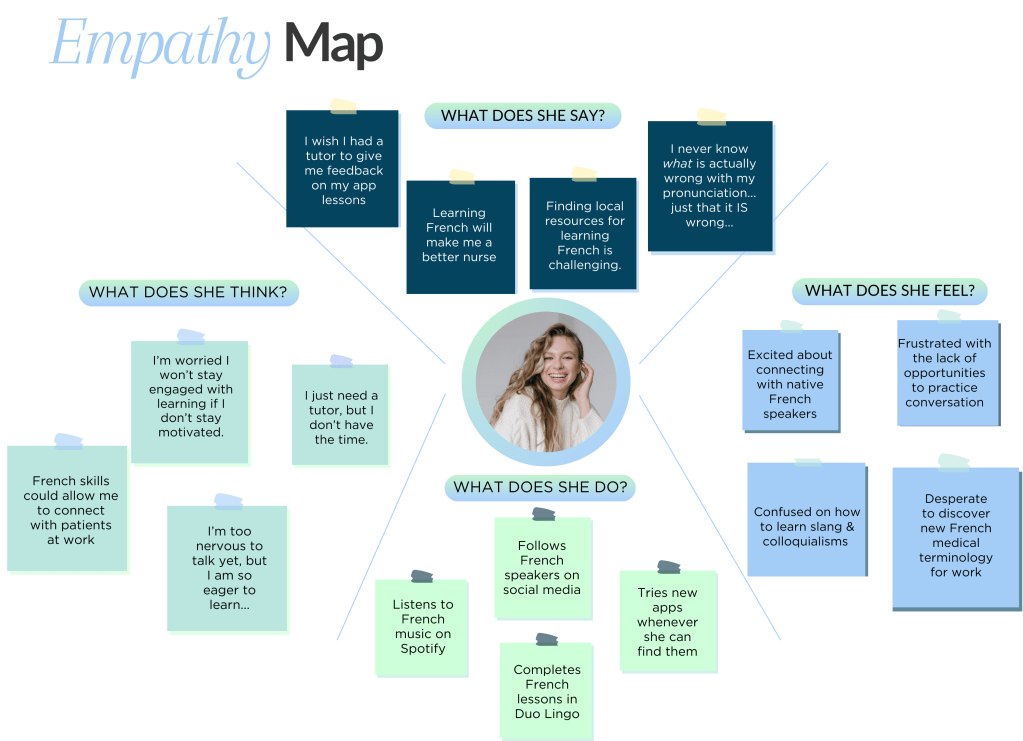
Personas
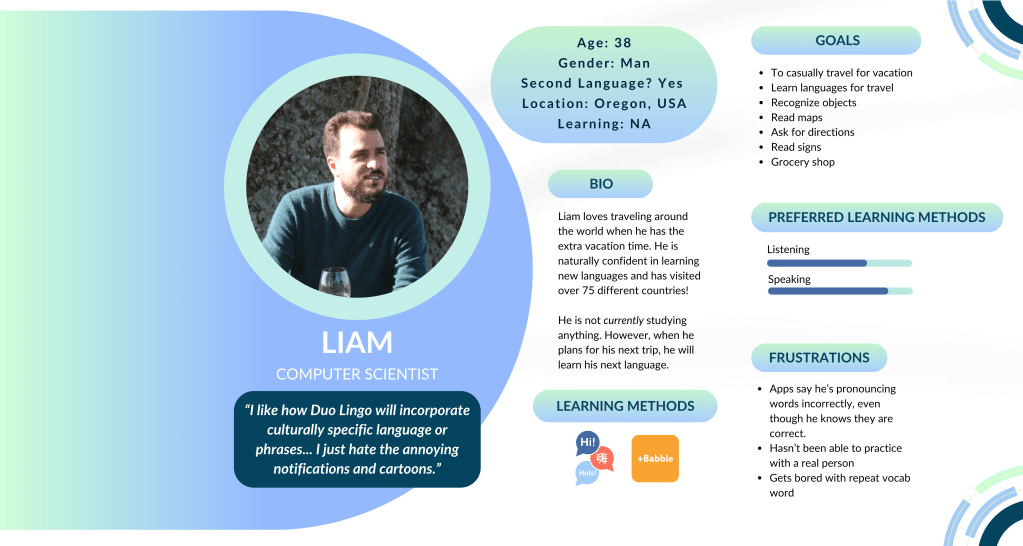
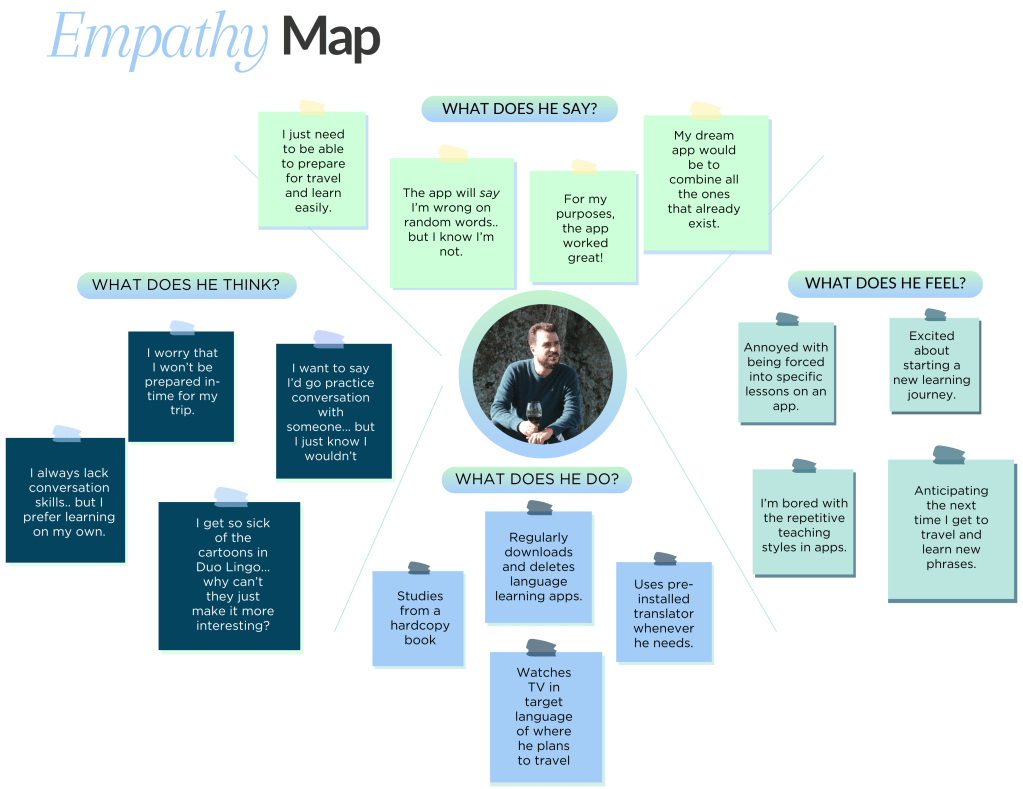
Things to be Done
- Continue learning language even in downtime.
- Find local speaking/language resources within the language learning app.
- Have conversations with native speakers without the pressure of public social situations.
- Have access to regularly updated vocabulary words that are relevant to specific jobs.
- Learn languages, conveniently, before traveling.
User Journey Map

Next Steps
“Mastering a single word today can open doors to conversations tomorrow…”
Recommendations
First, let’s remember our Jobs to be Done (JTBD):
- Continue learning language even in downtime.
- Find local speaking/language resources within the language learning app.
- Have conversations with native speakers without the pressure of public social situations.
- Have access to regularly updated vocabulary words that are relevant to specific jobs.
- Learn languages, conveniently, before traveling.
By incorporating everything we’ve found, the people we’ve met, and the insights we’ve learned, we have formulated the subsequent recommendations. These recommendations aim to create successful language acquisition. They ultimately enhance product satisfaction.
- Live Conversation Practice with Native Speakers:
- Introduce features that connect users with native speakers for real-time conversations, including private, low-pressure practice sessions. Incorporate expert feedback to help learners improve their speaking skills during or after sessions.
- Utilize generative AI to practice conversational text messaging.
- Introduce features that connect users with native speakers for real-time conversations, including private, low-pressure practice sessions. Incorporate expert feedback to help learners improve their speaking skills during or after sessions.
- Dynamic, Profession-Specific Learning Paths:
- Allow users to create and access custom vocabulary groups. Users can also create flashcards tailored to their professions. This ensures the app delivers relevant, job-specific content. Regularly update these resources to keep pace with industry trends and user needs.
- Engaging, Adult Learner-Oriented Content:
- Replace outdated, cartoonish, and simplistic content with mature, real-world scenarios that include slang, idioms, and conversational phrases. Offer interactive games that are both educational and appealing to adult learners, moving away from childish designs.
- Localized Resource Finder and Travel Prep Modules:
- Integrate a tool that helps users find local language meetups, events, and tutors through the app. Additionally, create specialized travel-focused learning paths that prepare users with essential phrases and cultural tips for their trips.
- Personalized, Encouraging Notifications:
- Redesign notification systems to be more supportive and personalized, aligning reminders with users’ progress and goals. This will help keep motivation without the pressure linked to more aggressive notification styles.
Future User Journey

 Kalene Savage